|
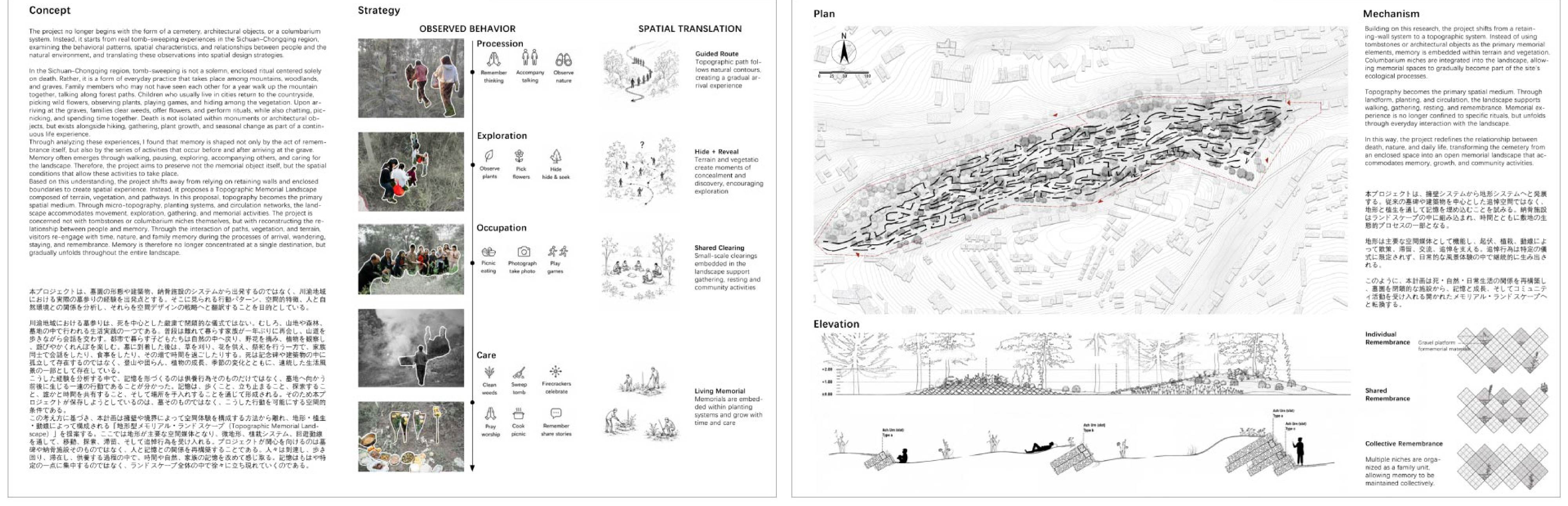
This project proposes an open public cemetery that embeds memory within topography and vegetation, moving away from traditional memorial spaces centered around tombstones, retaining wall systems, or enclosed columbaria. The design originates from real tomb-sweeping experience research in the Sichuan-Chongqing region. In this region, tomb-sweeping is not a solemn, enclosed ritual focused solely on death, but a form of everyday practice where families converse, picnic, and stroll in nature. Focusing on this behavior, the plan integrates columbarium niches into the landscape, allowing them to gradually become part of the site's ecological processes over time. Through landforms, planting, and circulation, the landscape supports walking, gathering, and interaction, conceiving a space that goes beyond ritualistic visits on specific days. It aims to create a memorial landscape that redefines the relationship between death, nature, and daily life by accommodating everyday community activities.
従来の墓碑や擁壁システム、閉鎖的な納骨堂を中心とした追悼空間ではなく、地形と植生を通して記憶を埋め込む開かれた公共墓地の提案である。四川・重慶地域における実際の墓参りの体験リサーチを出発点としている。同地域では、墓参りは死を中心とした厳粛で閉鎖的な儀式ではなく、自然の中で家族が語り合い、ピクニックや散策を楽しみながら過ごす日常的な実践である。この振る舞いに着眼し、納骨施設(壁龕)をランドスケープの中に組み込み、時間とともに生態学的プロセスの一部となる計画とした。起伏や植栽、動線によって散策や滞留、交流を支え、特定の日に先祖を訪ねる儀式的な場所にとどまらない空間を構想している。人々の普段の生活やコミュニティ活動を受け入れ、生と死、自然と日常の関係を再構築するメモリアル・ランドスケープを目指している。 |
|
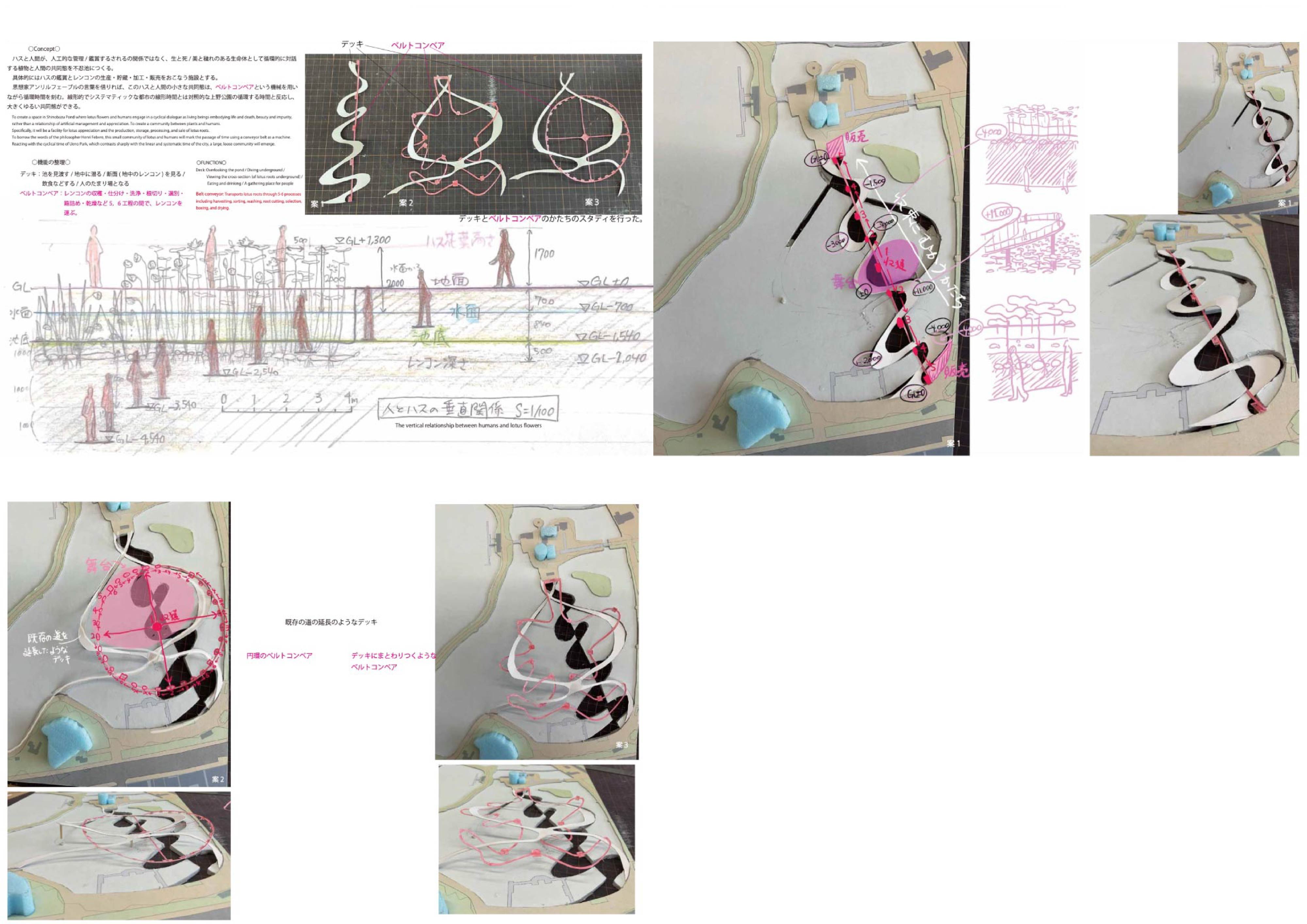
Set in Shinobazu Pond within Ueno Park, this proposal aims to create a plant-human community where humans and lotuses interact cyclically as living beings embodying life, death, beauty, and impurity, rather than a one-sided relationship of artificial management and appreciation. Specifically, the project designs a facility for lotus appreciation alongside the production, storage, processing, and sale of lotus roots (renkon). Borrowing concepts from philosopher Henri Lefebvre, a "belt conveyor" machine is integrated to transport lotus roots through five to six processes—including harvesting, sorting, washing, root cutting, selection, boxing, and drying—serving as a spatial device that marks the passage of cyclical time. This mechanical timeline intersects with pedestrian decks designed for overlooking the pond and observing the underground cross-sections of lotus roots. By reacting with the cyclical time of Ueno Park, which contrasts with the linear and systematic time of the city, the project seeks to generate a large, loose community that integrates agricultural production with human experience. 上野公園の不忍池を敷地に、人間とハスが管理・鑑賞という一方的な関係ではなく、生と死、美と穢れを併せ持つ生命体として対等かつ循環的に対話する共同態をつくる提案である。具体的には、ハスの鑑賞と、レンコンの生産・貯蔵・加工・販売を行う施設を設計する。思想家アンリ・ルフェーブルの概念を参照し、収穫・仕分け・洗浄・根切り・選別・箱詰め・乾燥といった5〜6工程の間でレンコンを運ぶ「ベルトコンベア」という機械を組み込み、循環する時間を刻む空間装置とした。この機械と、池を見渡し地中のレンコンの断面を観察できる歩行者用デッキとを交差させる。システマティックで線形的な都市の時間とは対照的な、上野公園の循環する時間と反応させることで、農業の生産プロセスと人々の体験が一体化した大きくゆるい共同態を生み出すことを目指している。 |
|
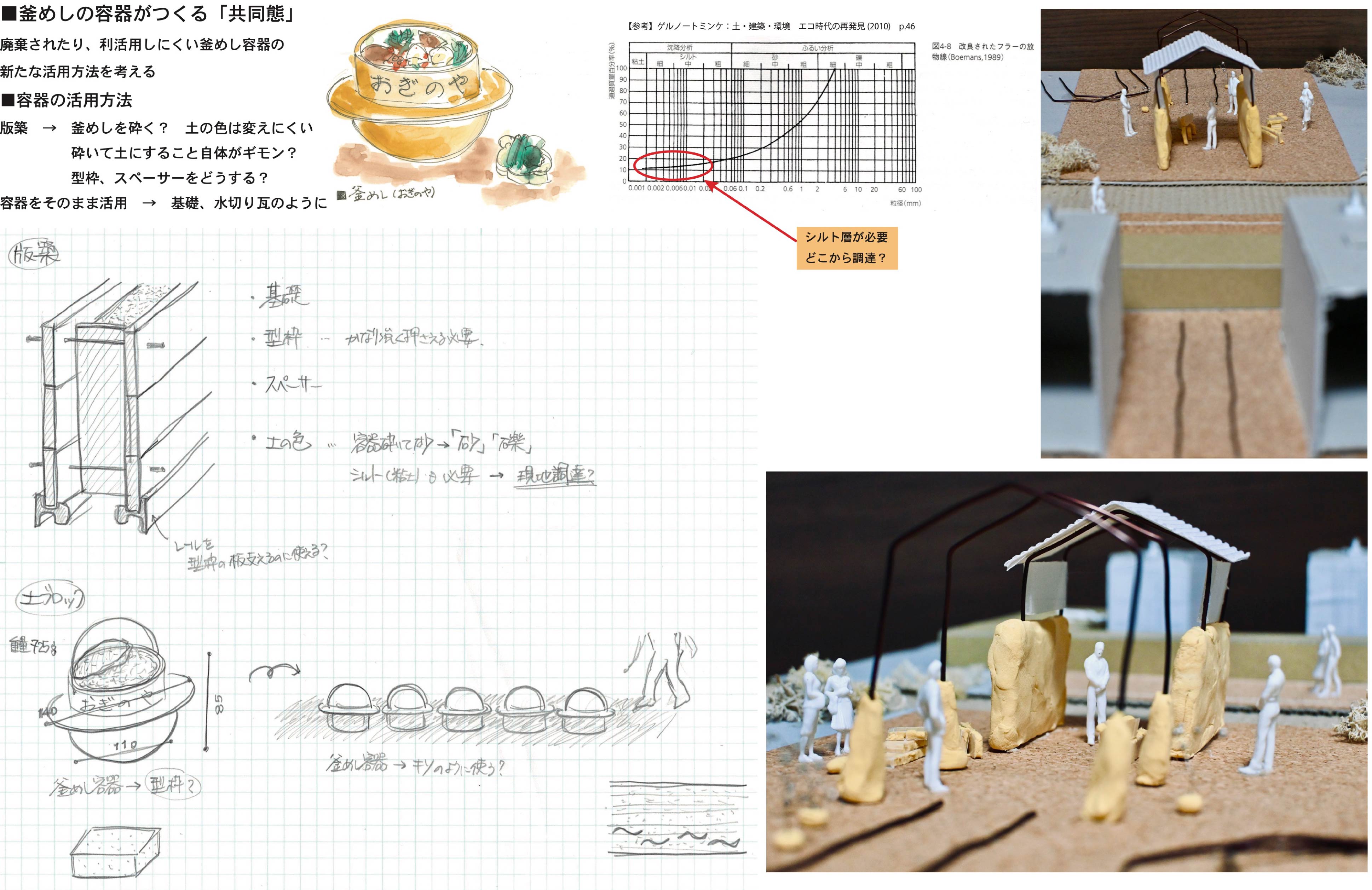
Targeting the abandoned railway tracks at Yokogawa Station, this project proposes a process-oriented architecture that forms a new community by reusing discarded containers of "Toge no Kamameshi" (Oginoya). Focusing on ceramic kamameshi pots that are typically discarded and difficult to utilize, the student explores spatial design strategies to repurpose them as architectural elements. While initially considering crushing the containers to use as material for rammed earth walls or bricks, the student developed the construction logic by studying how to utilize the container's original shape directly for foundations, water-shedding tiles, formwork, and spacers due to challenges regarding soil color, strength, and formwork execution. Rather than merely aiming to construct a completed structure, the proposal intends to create a new commons connecting the station with the local society through the building process itself, where community members gradually expand the architecture using the kamameshi pots.
横川駅の線路跡地を対象に、かつて長時間停車する列車向けに売られていた「峠の釜めし(おぎのや)」の廃容器を再利用し、新たな共同態を形成するプロセスの建築の提案である。廃棄されやすく利活用が難しい陶器製の釜めし容器に着目し、それを建築部材としてどのように転用するかを模索している。当初は容器を砕いて版築の壁やレンガの材料とすることを検討したが、土の色や強度、型枠などの施工上の課題から、容器の形状をそのまま基礎や水切り瓦、型枠、スペーサーとして活用する施工ロジックへとスタディを展開させた。完成された構造物を建てることだけを目的とせず、地域の人々が釜めしの容器を用いて基礎や壁を作り、建築を徐々に拡張していく構築プロセスそのものを契機として、駅と地域社会を繋ぐ新たなコモンズを生み出すことを目指している。 |
Copyright (C) 2014 Watanabe Taishi Laboratory, Department of Architecture, Waseda University. All Rights Reserved.