|
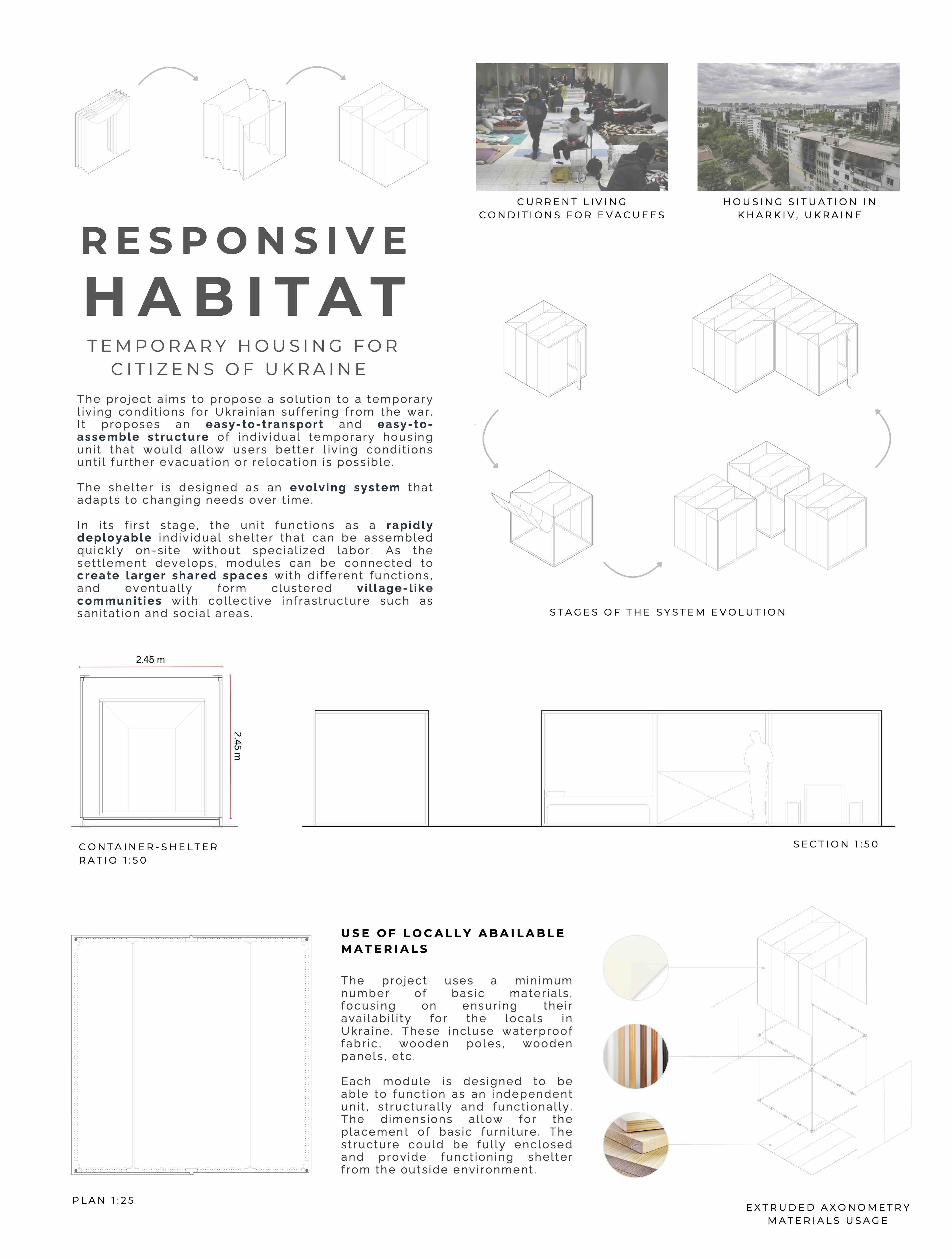
This project, "Responsive Habitat," proposes individual temporary housing units for Ukrainian evacuees who have lost their homes and endure harsh communal life lacking privacy. To improve temporary living environments, it features a lightweight structure that is easy to transport and assemble. Each $2.45\text{ m} \times 2.45\text{ m}$ module accommodates essential furniture and is optimized to fit precisely five units inside a standard shipping container for efficient mass transportation. On-site, evacuees can swiftly assemble the frame without specialized machinery; it simply unfolds and clicks into a locked position. This folding mechanism utilizes 3D-printed custom joints. The construction relies on a minimum number of basic materials easily available in Ukraine, such as waterproof fabrics, wooden poles, and panels. Furthermore, the shelter is an evolving system adapting to changing needs. Initially functioning as isolated individual shelters, these modules can horizontally interconnect over time to build larger shared spaces with various functions, eventually forming village-like humanitarian communities equipped with collective infrastructure.
戦争や災害で住まいを失い、プライバシーの欠如した過酷な集団避難生活を余余儀なくされているウクライナの避難民を対象とした、個人用仮設住宅ユニット「レスポンシブ ハビタット」の提案である。暫定的な避難環境を改善するため、持ち運びと現場組み立てが容易な軽量構造を特徴とする。各モジュールは $2.45\text{ m} \times 2.45\text{ m}$ の基本寸法で、最低限の家具を配置できる空間を確保しつつ、輸送用コンテナに5つ収まるサイズに最適化し、陸路での大量輸送を可能にした。現場では、特殊な機材を使わず被災者自身の手でフレームを開くだけでロックがかかり、短時間で組み立てられる仕組みを3Dプリント接合部として設計した。資材には現地のホームセンター等で入手できる防水布、木製ポール、パネルなどの最小限の基本資材を採用している。さらに、最初は独立した個人の避難拠点として機能し、のちにはモジュール同士を拡張・連結して多様な共有スペースを構築、最終的には衛生設備を備えた集落型のコミュニティへと動的に発展していける可変的なシステムである。 |
|
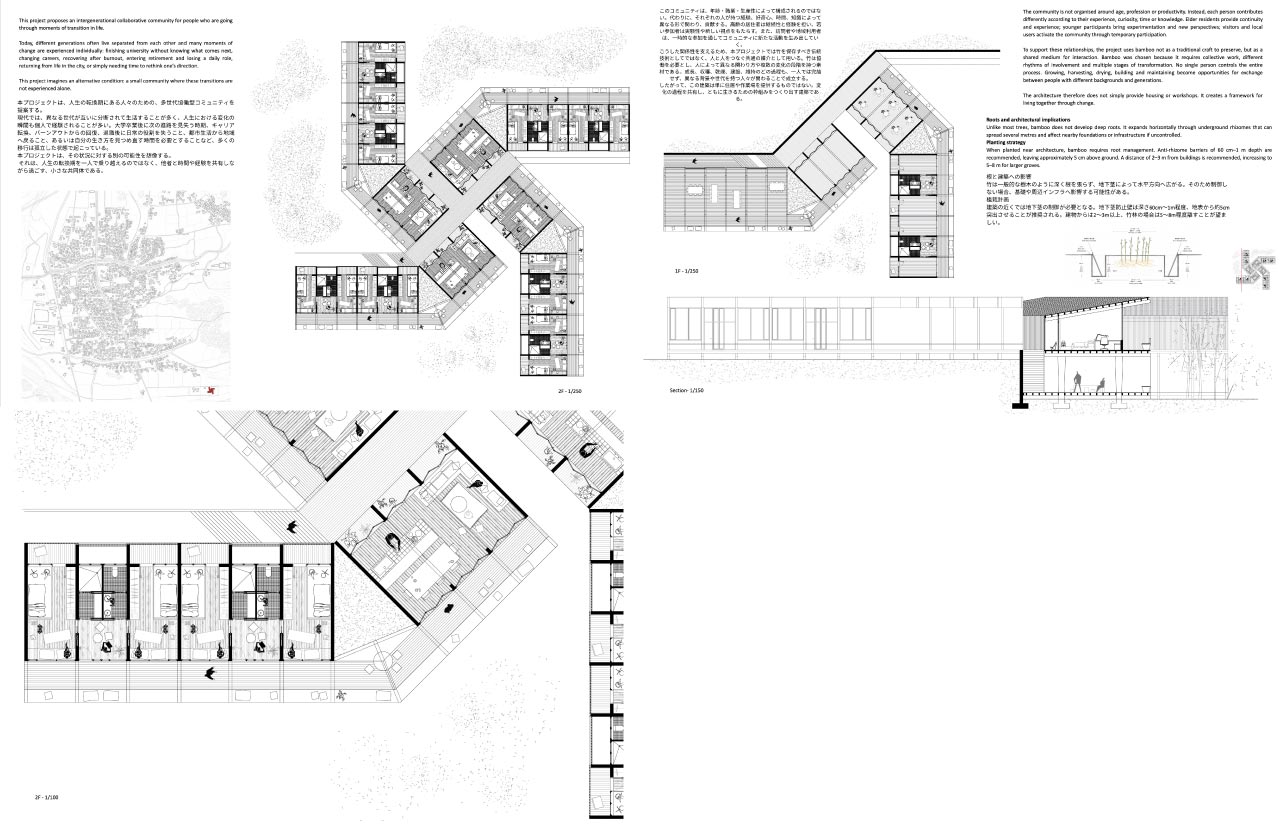
This project, "Living Between Stages," imagines an alternative possibility for contemporary society, where different generations often live separated, and major life transitions—such as finishing university without a path, career shifts, burnout recovery, or retirement—are frequently experienced in isolation. Rather than enduring these crossroads alone, this project proposes a small, intergenerational collaborative community where individuals share time and experiences. Each resident contributes uniquely based on their personal experience, curiosity, time, and knowledge. To support these relationships, the project introduces bamboo into the architecture as a dynamic, shared medium for human interaction. Working with bamboo naturally demands collective labor; its chronological phases—including planting, harvesting, drying, building, and maintenance—turn material processes into everyday architectural routines for people of different generations to share change. Furthermore, to prevent bamboo's characteristic horizontal underground rhizomes from affecting foundations, the design integrates a root management strategy: installing anti-rhizome barriers with a depth of 60 cm to 1 m, leaving 5 cm above ground, and maintaining a distance of at least 2 to 3 meters from buildings.
現代社会において異なる世代が分断されて生活し、進路模索、キャリア転換、バーンアウトからの回復、退職といった人生の重要な移行期の多くが、孤立した状態で経験されている現状に対する別の可能性を想像する「人生の途中で暮らす」の提案である。こうした人生の岐路を一人で乗り越えるのではなく、他者と時間や経験を共有しながら過ごす多世代協働型の小さな共同体を構想している。このコミュニティでは、年齢や経済的な生産性にとらわれず、居住者が持つ経験や知識に応じて異なる形で関わり、貢献し合う。この多世代間の関係性を支える枠組みとして、竹を人と人を繋ぐ共通の媒介(メディア)として建築に導入している。竹の活用は、植栽管理、収穫、乾燥、建設、維持管理にいたる全てのプロセスにおいて一人では完結せず、多様な背景を持つ人々による集団作業と時間的な変化の共有を要求する。また、地下茎が基礎へ影響を及ぼさないよう、深さ60cm〜1mの防止壁を地表から5cm突出させ、建物から2〜3m以上離す具体的な管理戦略も組み込んでいる。 |
|
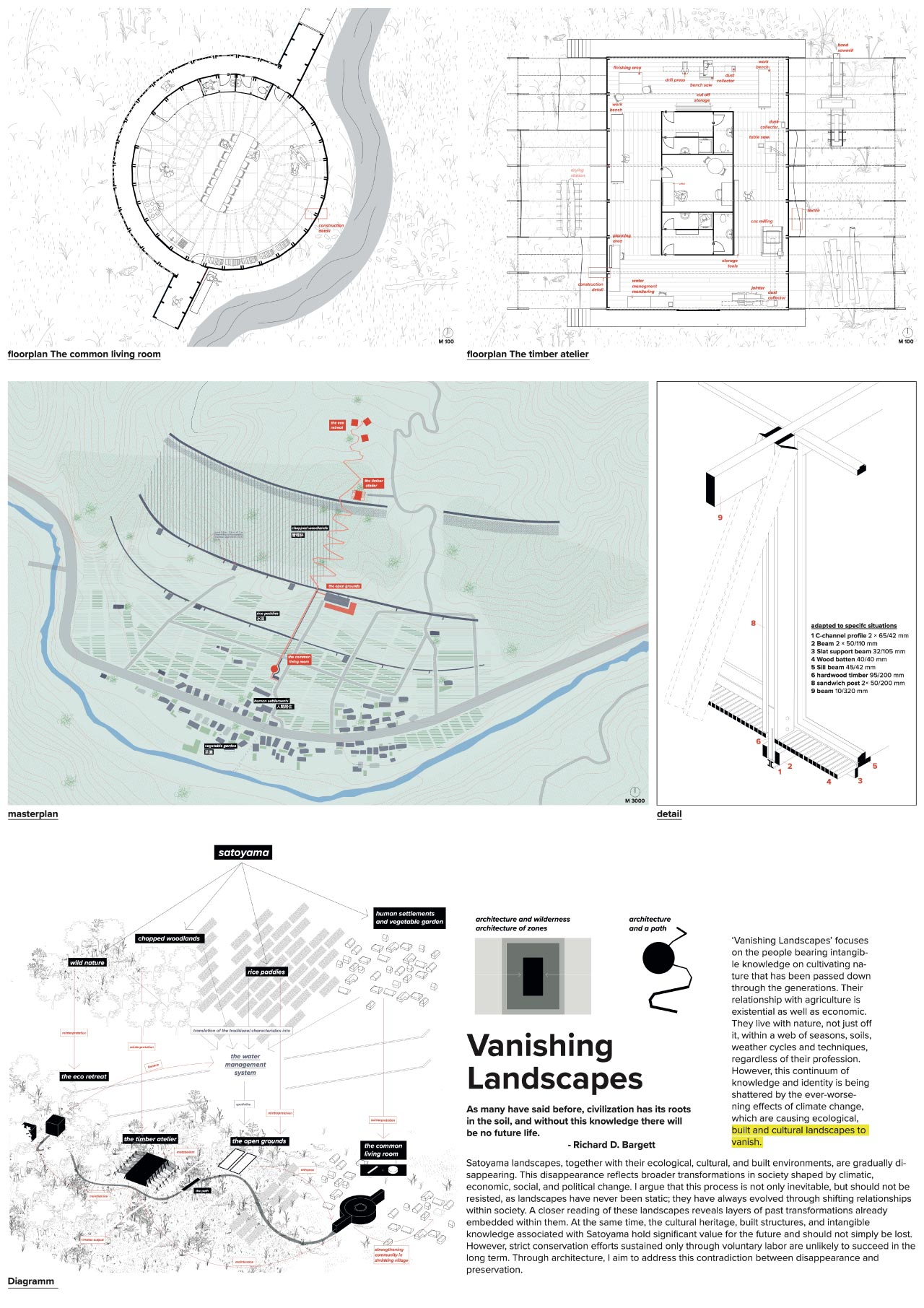
This project, "Vanishing Landscapes," proposes an architectural intervention into the contradiction between the disappearance and preservation of Satoyama landscapes, which are rapidly vanishing due to socioeconomic transformations and climate change. Arguing that landscapes are never static and that strict conservation sustained solely through voluntary labor has its limits, the design explores a space where local people live in harmony with nature, embedded within a web of seasons and topography. Specifically, the design translates the traditional landscape mosaic—such as managed woodlands and rice paddies—into physical architectural structures interconnected with a water management system. This system captures and returns water to nature via percolation zones, acting as a safety valve against environmental risks. The "common living room," the focus of the detailed study, functions as an informal space to support daily social interactions and communal gatherings for a shrinking, aging village. Structurally, it utilizes a sandwich post construction system made of locally sourced timber; this allows components to remain small enough for community assembly without heavy machinery, creating a blurred boundary between inside and outside.
社会構造の変化や気候変動の深刻化によって、地域の生態系や文化的背景が一体となった里山景観が急速に消失しつつある現状に対し、建築を通じて「消失」と「保存」の矛盾に介入する計画「消えゆく風景(仮)」の提案である。景観は本来静的なものではなく、無償のボランティアだけに頼る厳格な保存活動には限界がある。本計画では、人々が自然を消費するだけでなく、四季や地形、水循環のネットワークの中で調和して生きるための空間を模索する。具体的には、雑木林や水田のモザイクを物理的な建築構造へと翻訳し、地域全体の水管理システムと直結させた。水は地表の施設を巡ったのち、地下浸透(パーコレーション)ゾーンを経て自然へと還され、環境リスクに対する安全弁として機能する。詳細設計の「共同リビング」は、人口減少・高齢化が進む限界集落において日常的な交流や住民の集会を支える場となる。構造面では、現地調達可能な木材を用いたサンドイッチ状のポスト工法を採用し、重機を使わず人の手で組み立てられる小さな部材で構成することで、内外の境界が滲む空間を作り出している。 |
|
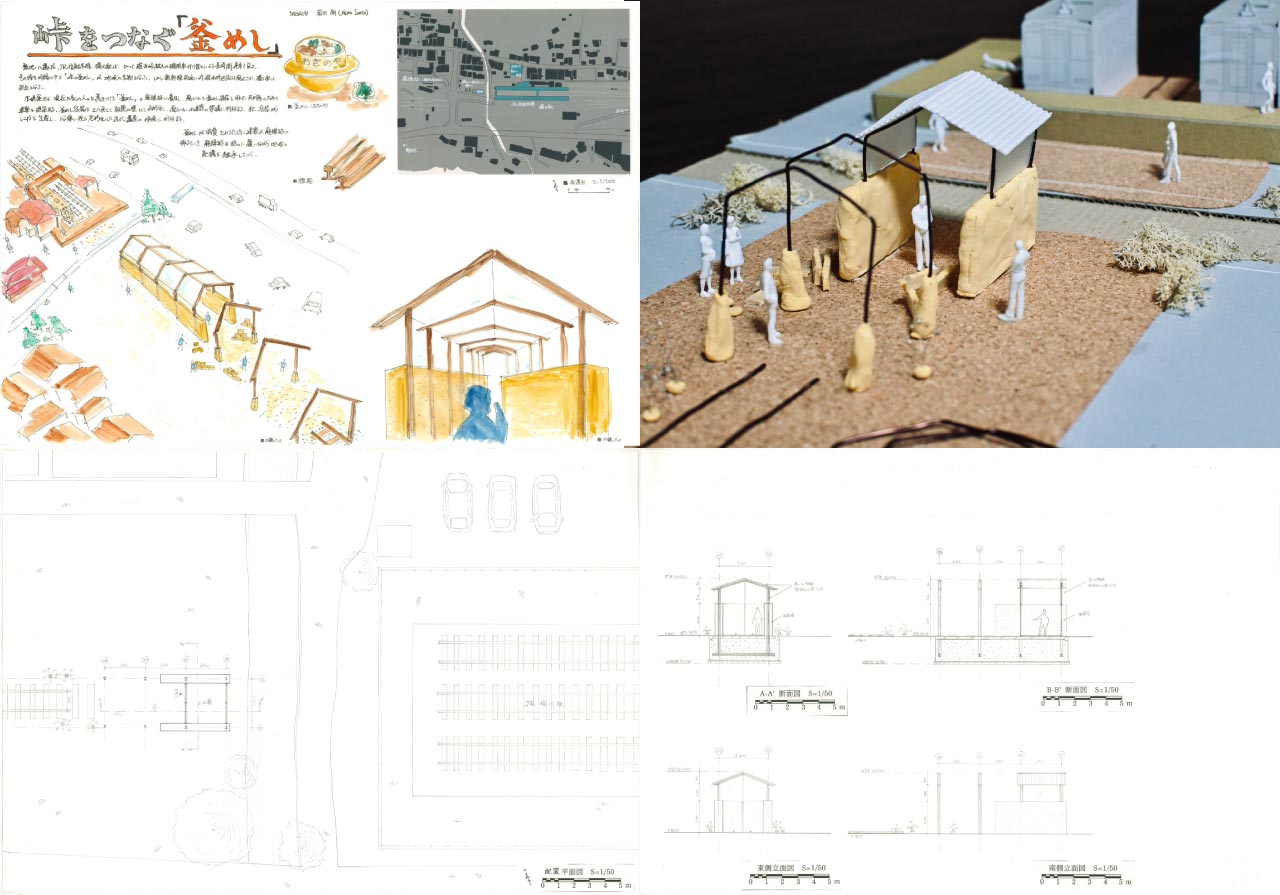
This project focuses on the JR Shin-etsu Main Line's Yokogawa Station, historically the site where locomotives were swapped due to a steep railway incline, during which "Toge no Kamameshi" became a famous local specialty. With the opening of the Shinkansen, the conventional line section was abandoned, and Yokogawa Station became a terminus. This proposal focuses on the "Kamameshi" culture, which still attracts visitors, and the abandoned railway tracks to propose a community architecture using two symbolic local resources: discarded Kamameshi pots and old rails. The primary gimmick is recycling these materials: the clay of the Mashiko-ware pots, which usually become waste, is returned to soil and reused for rammed-earth walls, while the abandoned rails are repurposed as structural steel frames. As Kamameshi is consumed and containers accumulate, the building incrementally expands along the abandoned tracks, gradually inheriting the memory of the region. Furthermore, the project aims to produce bricks from the surplus clay of the pots to restore and maintain aging modern industrial heritages, such as historic brick tunnels, thereby bridging a framework for the local community to sustain regional identity into the future.
かつてJR信越本線の横川駅が急勾配による機関車の付け替え拠点であり、その停車時間の間に誕生して今なお人々を惹きつけている「峠の釜めし」と、新幹線開業によって一部が廃線となり終点となった在来線の廃線跡に着目した共同体のための建築提案である。食べ終えた後にゴミとなってしまっている益子焼きの「釜めし容器」と、使われなくなった「廃レール」という2つの地域資源を建築材料として転用・リサイクルすることを最大のギミックとしている。具体的には、廃棄された容器を一度土に戻して建築の「版築の壁」として再利用し、廃線跡のレールを建築の構造体として利用する。釜めしが消費され容器が廃棄されるたびに、その土を用いて建築が廃線跡に沿ってどんどん伸びていく成長型の増築プロセスを考えている。さらに、余剰となる容器の土からレンガを生産し、沿線に残る古いトンネルなどの近代産業遺産の修復・継承アクティビティに役立てることで、地域の記憶と文化を未来へ繋ぐ共同体の枠組みを構築する。 |
Copyright (C) 2014 Watanabe Taishi Laboratory, Department of Architecture, Waseda University. All Rights Reserved.