|
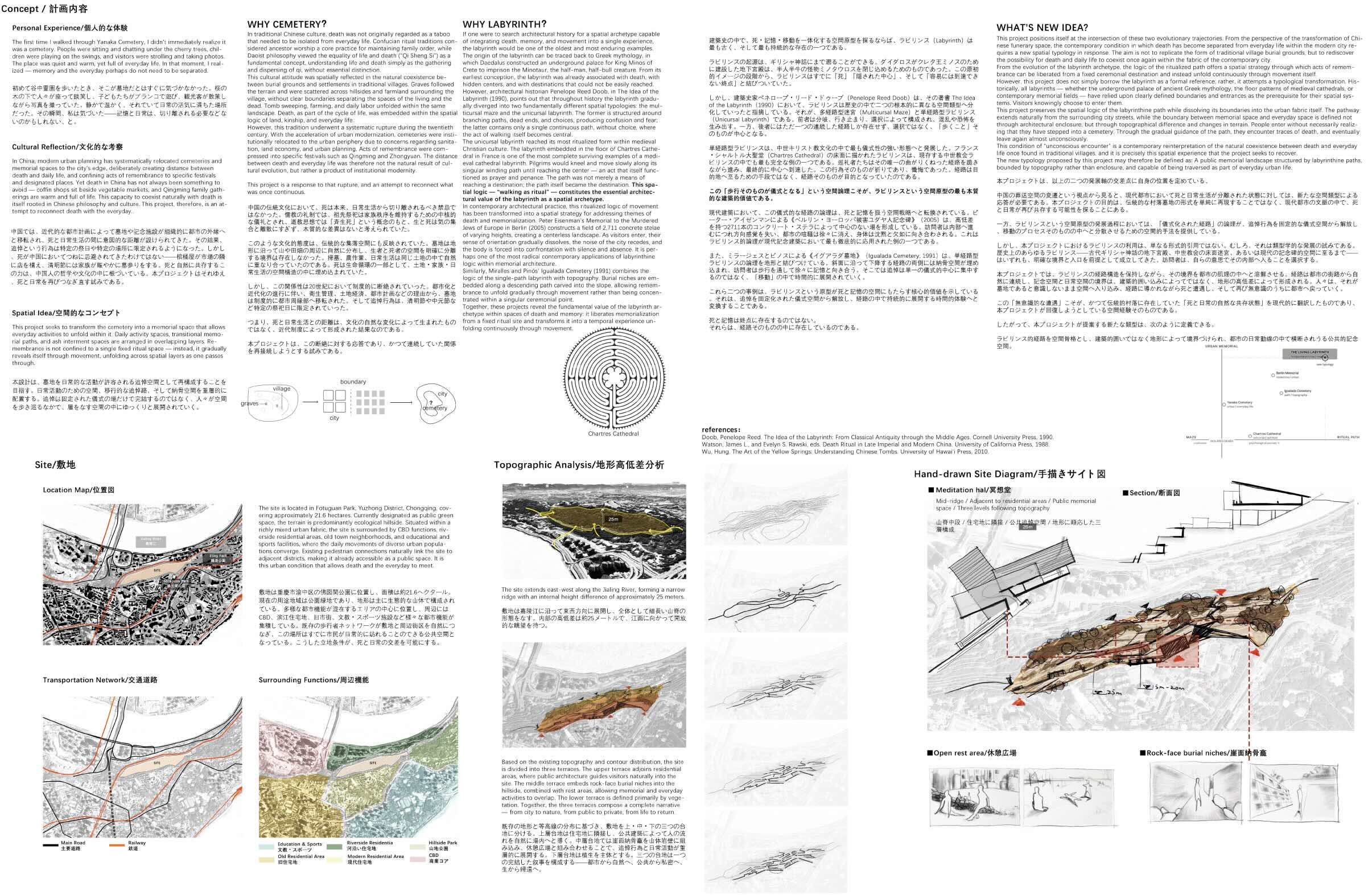
This project attempts to reconnect the space of "death," which has been pushed to the periphery by modern urban planning and detached from daily life, back into the center of the city. The site is a mountain park with a 25-meter elevation change surrounded by the urban area of Chongqing. Drawing from the "coexistence of death and daily life" in traditional Chinese culture, the project introduces the "labyrinth"—a structure with a single continuous path meant to be walked—as a spatial method. By configuring the circuit path without clear boundaries using topographic changes and layered vegetation, it creates an open public cemetery where people naturally encounter memories of death as an extension of their daily lives and return to the everyday.
現代の都市計画によって辺境へ追いやられ、日常から切り離されてしまった「死」の空間を、都市の中心に再結合する試みである。敷地には、重慶市の市街地に囲まれた高低差25メートルの山岳公園を選定。伝統的な中国文化における「死と日常の共存」を背景に、一本の連続する経路をひたすら歩む構造を持つ「ラビリンス(迷宮)」を空間手法として導入する。地形の高低差や折り重なる植栽を用いて明確な境界線を設けずに回遊路を構成することで、人々が日常の延長として自然に死の記憶へ遭遇し、再び日常へと還っていくような開かれた公共墓地を創出する。 |
|
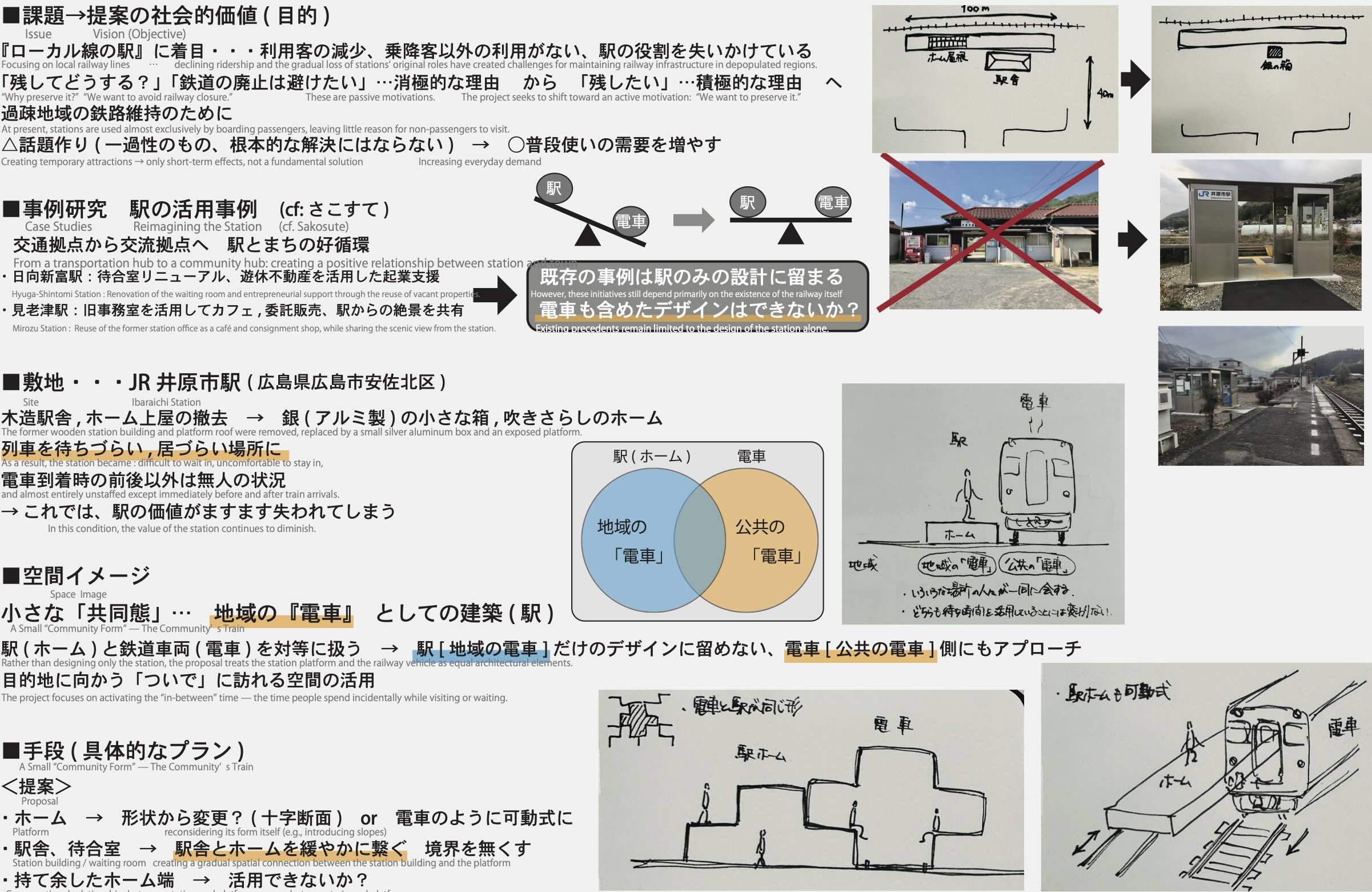
This proposal rejuvenates a local railway station, whose infrastructure is threatened by declining ridership, into an everyday hub for community interaction. The site is JR Ibaraichi Station in Hiroshima, where the original building and roof have been removed, leaving an exposed platform. Iwata criticizes traditional designs that limit focus strictly to the station premises and explores an "integrated design including the train itself," treating the platform and the rail vehicles equally. Specifically, the design introduces a "cross-sectional" shape where the train and platform interlock, along with movable platforms. The goal is to activate the in-between time of transit and spark an active local community.
利用客の減少によりインフラ維持が危ぶまれるローカル線の駅を、地域住民が普段使いできる交流拠点へと再生する提案である。敷地は、駅舎や屋根が撤去され風雨にさらされている広島県のJR井原市駅。岩田は、従来の「駅の敷地内」だけに留まる設計を批判し、駅ホームと鉄道車両(電車)を対等に扱う「電車も含めた一体のデザイン」を模索する。具体的には、車両とホームが噛み合う「十字断面」の造形や可動式ホームの導入などを提示。移動の合間の時間をアクティベートし、能動的な地域コミュニティを誘発する空間を目指す。 |
|
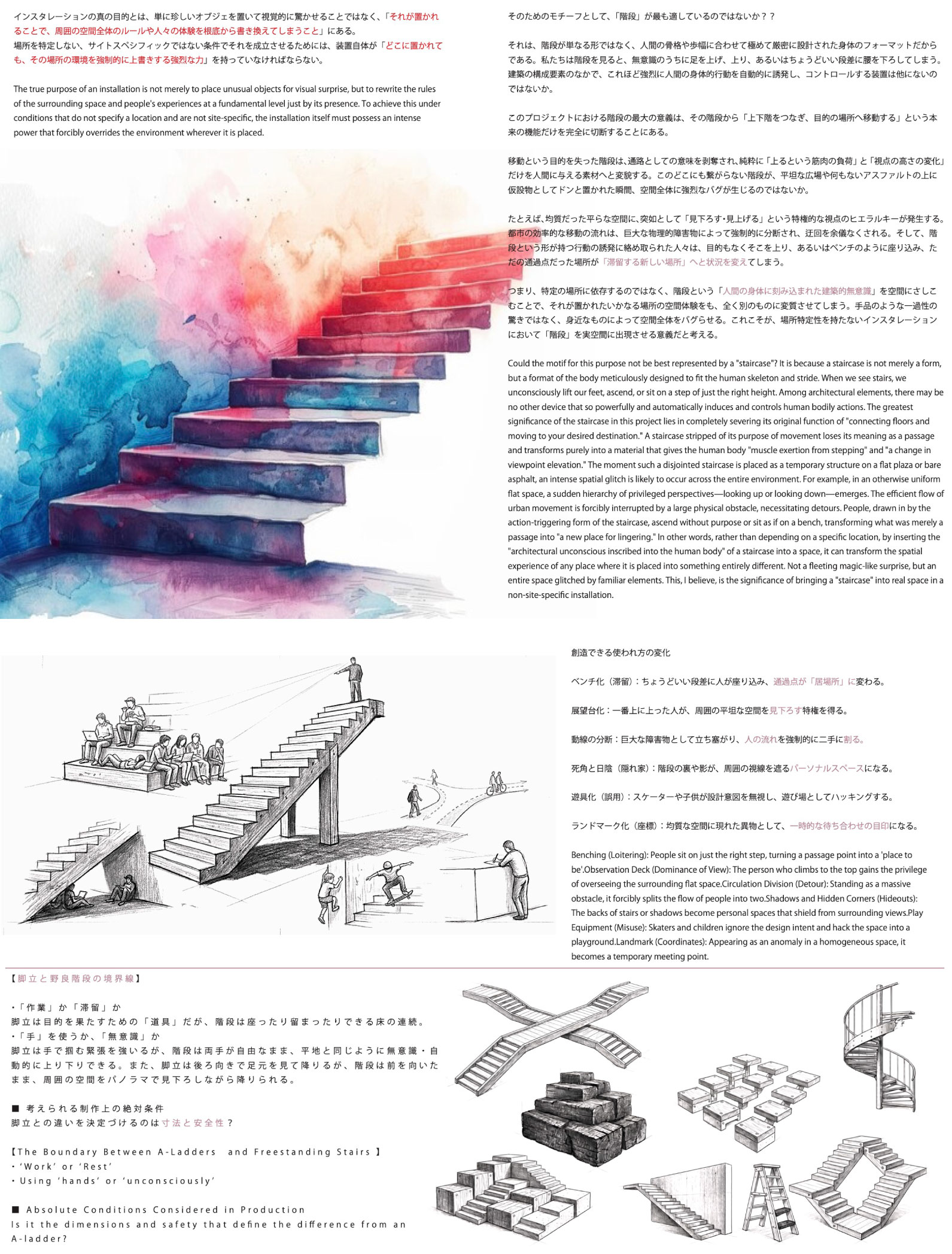
This is a proposal for a non-site-specific temporary installation that, by its mere presence, fundamentally rewrites the rules of the surrounding space. Date focuses on stairs as a "body format"—a structure designed precisely around the human skeleton and stride that automatically triggers climbing or sitting. This installation completely detaches the original function of stairs, which is to connect levels for purposeful transit, and abruptly places them in a flat square. Losing its destination, the staircase suddenly generates a visual hierarchy of looking up and down, disrupting urban circulation. It catches people in purposeless ascent or rest, drastically transforming homogenous space.
置かれるだけで周囲の空間ルールを根底から書き換えてしまう、場所を特定しない仮設インスタレーションの提案である。伊達は、人間の骨格に合わせて厳密に設計され、見るだけで昇降や着座を自動的に誘発する「身体のフォーマット」として階段に着目。この装置から「上下階をつなぐ目的地への移動」という本来の機能を完全に切断し、平坦な広場へ唐突に配置する。目的を失った階段は、「見上げる・見下ろす」という視点のヒエラルキーを突如発生させ、都市の動線を分断。人々を目的のない上昇や滞留へ絡め取り、均質な空間を劇的に変革する。 |
|
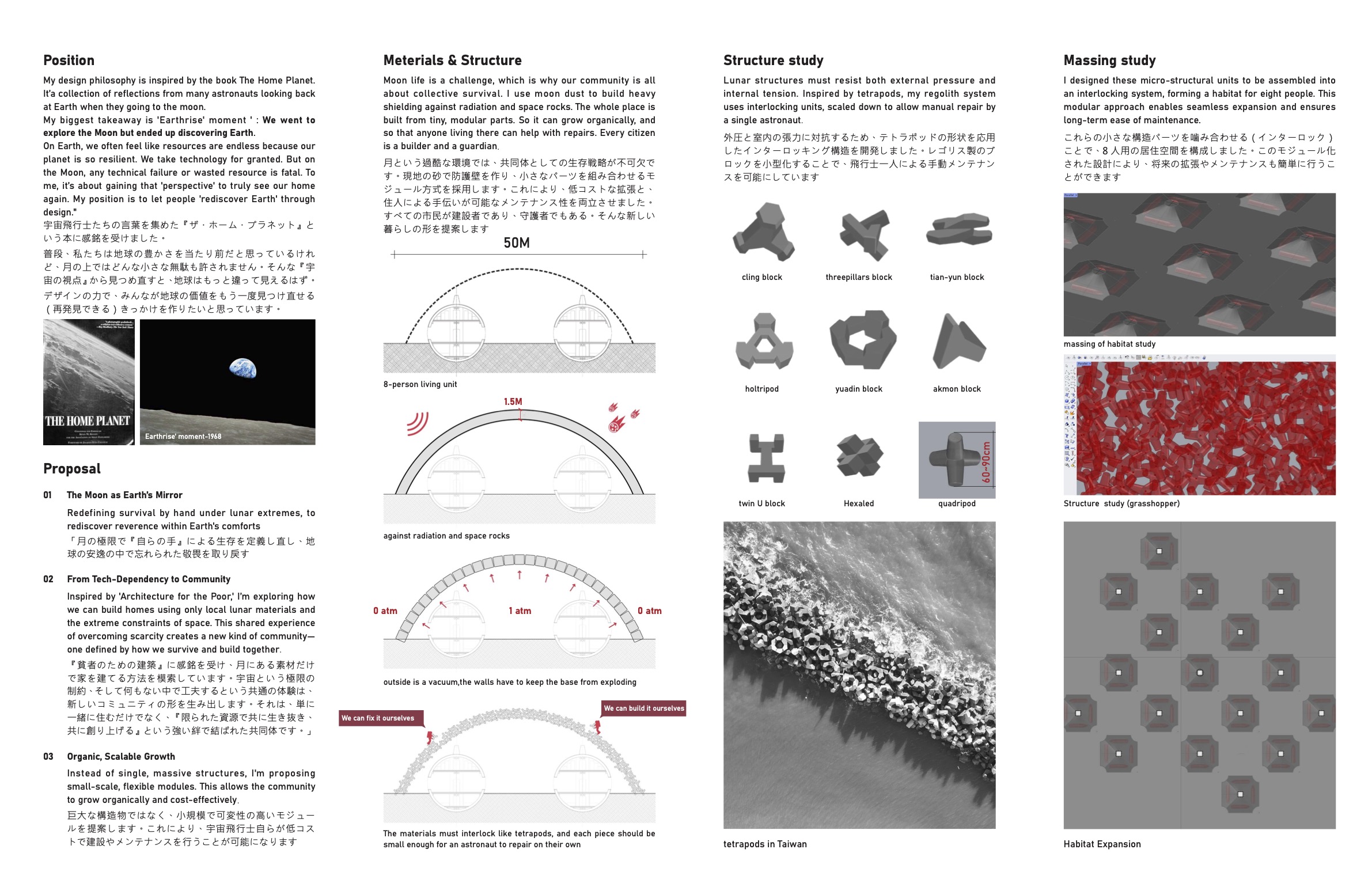
This design approach rediscovers the true value and reverence of Earth through manual survival strategies in the extreme lunar environment. To counter radiation protection and pressure retention on the Moon, it explores building shields using only local moon dust (regolith) rather than transporting materials from Earth. Developing a block system inspired by tetrapods in Taiwan, the components are modularized to a size that a single astronaut can manually maintain without heavy machinery. Using an 8-person habitat unit as the minimum cell, citizens become the builders to expand the space organically, fostering a community of collective survival.
月の極限環境における手作業の生存戦略を通じて、地球の真の価値と敬畏を再発見させるデザインアプローチである。月面での放射線防護や気圧保持に対抗するため、地球からの資材搬入ではなく、現地にある月の砂(レゴリス)のみを用いた防護壁の構築を模索。台湾のテトラポッドの形状を応用したブロックシステムを開発し、重機のない環境で宇宙飛行士が一人で手動メンテナンスを行えるサイズにモジュール化する。8人用の居住ユニットを最小単位とし、市民自らが建設者となって有機的に空間を拡張していくプロセスを通じ、「共に生き抜く絆」の共同体を創り出す。 |
|
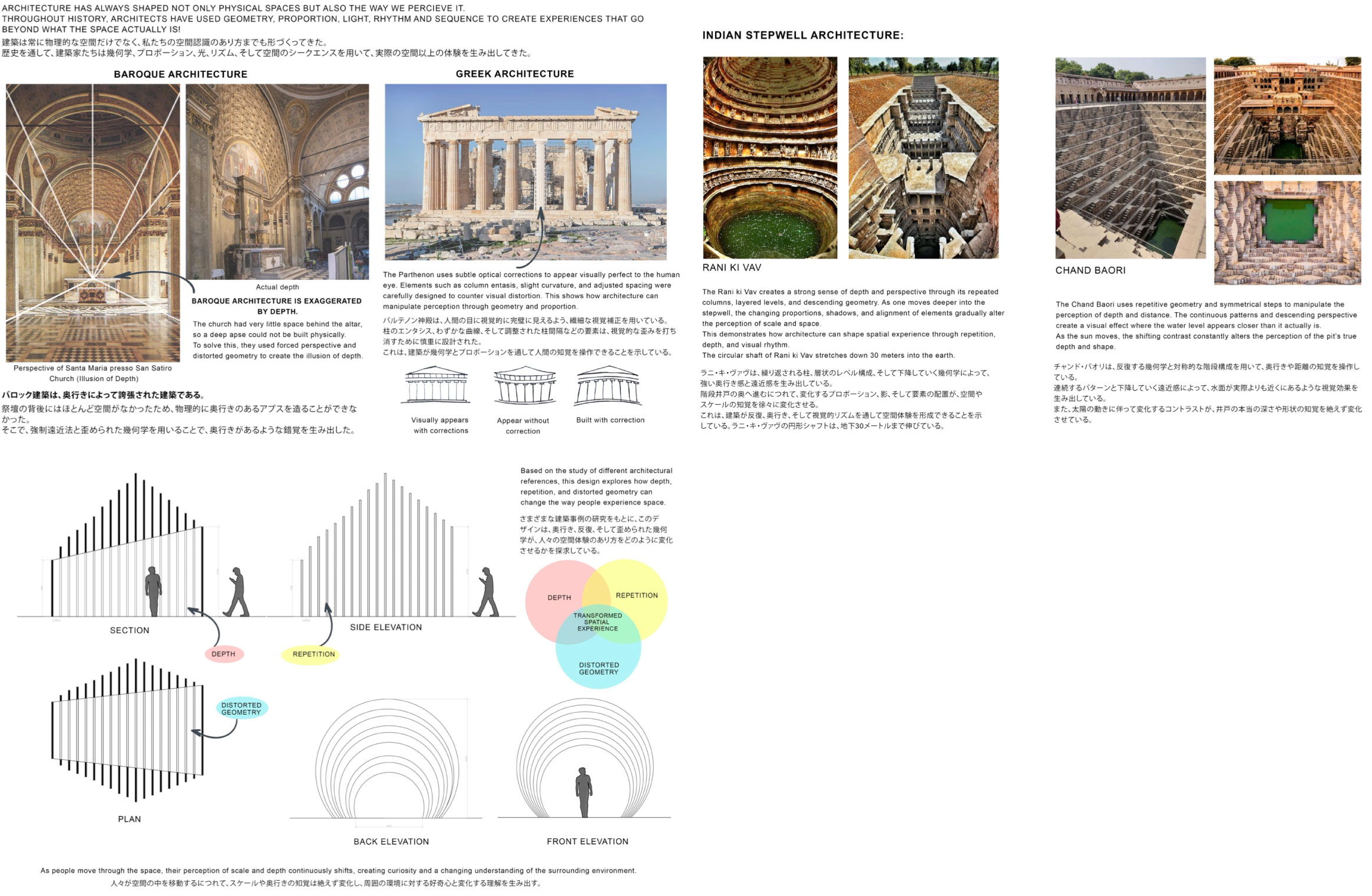
This is an exploration of "perceptual control," manipulating geometry, proportions, and spatial sequences to create an experience of expanse beyond physical dimensions. The study analyzes Baroque architecture, which used forced perspective to create deep illusions in tight spaces, and the Parthenon, which employed subtle optical corrections to negate visual distortion. Furthermore, it examines Indian stepwells, where repetitive columns and symmetrical steps use descending perspective to ease the fear of depth. Based on these references, Shruti designs a unique model merging depth, repetition, and distorted geometry, aiming to create an experiential space where the perception of scale constantly shifts with movement.
幾何学やプロポーションの配列(シークエンス)を操作し、人間の物理的寸法を超えた広がりを感じさせる「知覚のコントロール」の探求である。強制遠近法で狭い空間に深い奥行きを錯覚させたバロック建築や、歪みを打ち消す視覚補正を用いたパルテノン神殿を分析。さらにインドの階段井戸における、深さへの恐怖を和らげる反復する柱や対称ステップの下降遠近法による知覚操作を考察する。これらの研究をもとに「奥行き」「反復」「歪んだ幾何学」を融合した独自のモデルを設計。移動に伴いスケール認識が絶えずシフトする体験空間の創出を目指す。 |
Copyright (C) 2014 Watanabe Taishi Laboratory, Department of Architecture, Waseda University. All Rights Reserved.