|
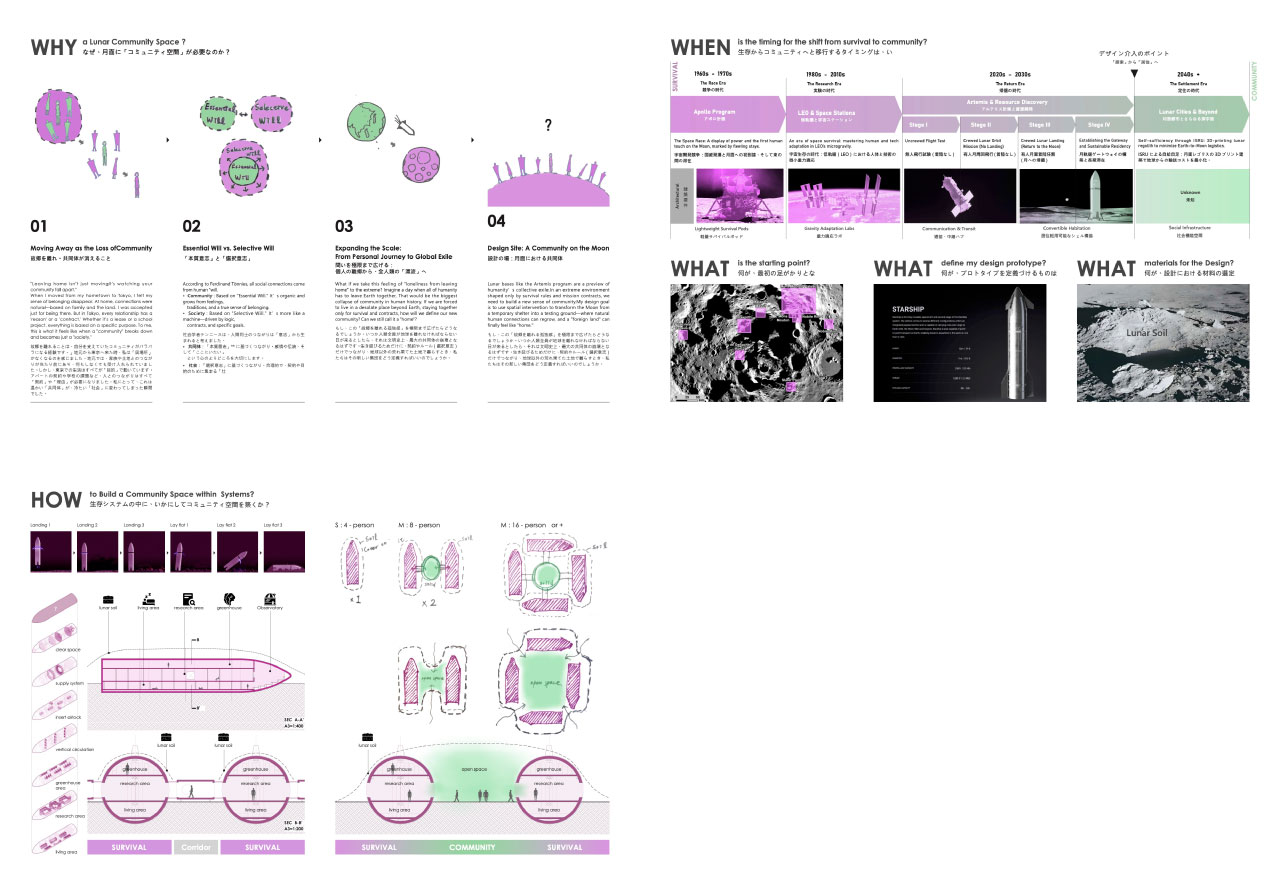
This project is an architectural proposal for the near future of lunar exploration, aiming to transform a mere "facility" for survival into a "community" that fosters human connection. The conceptual core lies in the distinction between "Society, " which is based on purpose, reason, and contracts, and "Community, " which is rooted in natural, essential belonging. As people move from hometowns to mega-cities, natural ties often dissolve into contractual relationships; the moon, as a frontier, risks becoming a cold "society" of pure survival logic. This design seeks to establish a "Home" on the lunar surface that provides a sense of belonging beyond mere life support.
The proposal utilizes a Starship-based prototype, layered into three distinct functional zones: an infrastructure layer for fundamental survival, a production layer featuring greenhouses for self-sufficiency, and a public layer designed to encourage social interaction. To minimize the massive logistics costs from Earth, the plan incorporates In-Situ Resource Utilization (ISRU) technology, specifically using 3D-printed lunar regolith to construct protective shell structures. This approach envisions a transition from an "exploration" phase to a "settlement" era, where architectural systems support long-term residency and the organic growth of a lunar communal identity.
本計画は、人類の月面探査が進む近未来において、単なる生存のための「施設」を、人間的なつながりを育む「共同体」へと昇華させる建築的提案である。構想の核となるのは、目的や理由、契約に基づく「社会(ソサエティ)」と、自然発生的で本質的な帰属意識に基づく「共同体(コミュニティ)」の対比である。地方から大都市へ移住する際に感じる、地縁的なつながりが契約関係へと変容してしまう違和感を背景に、極限環境である月面が単なる生存ロジックのみの冷淡な場になることを防ぎ、心の拠り所としての「家」を再構築することを目指す。 具体的な設計手法として、スターシップをプロトタイプとし、内部を生存のためのインフラ層、自給自足を担う温室生産層、そして人々の交流を促す公共層へと階層化して構成する。また、地球からの輸送コストを最小化するため、月面の土壌(レゴリス)を3Dプリントしてシェル構造を構築するISRU(現地資源利用)技術の活用を想定している。この提案は、「探査」から「定住」への移行期における建築モデルであり、長期滞在を支えるシステムの中に、いかにして有機的な共同体のアイデンティティを育むかを問いかけている。 |
|
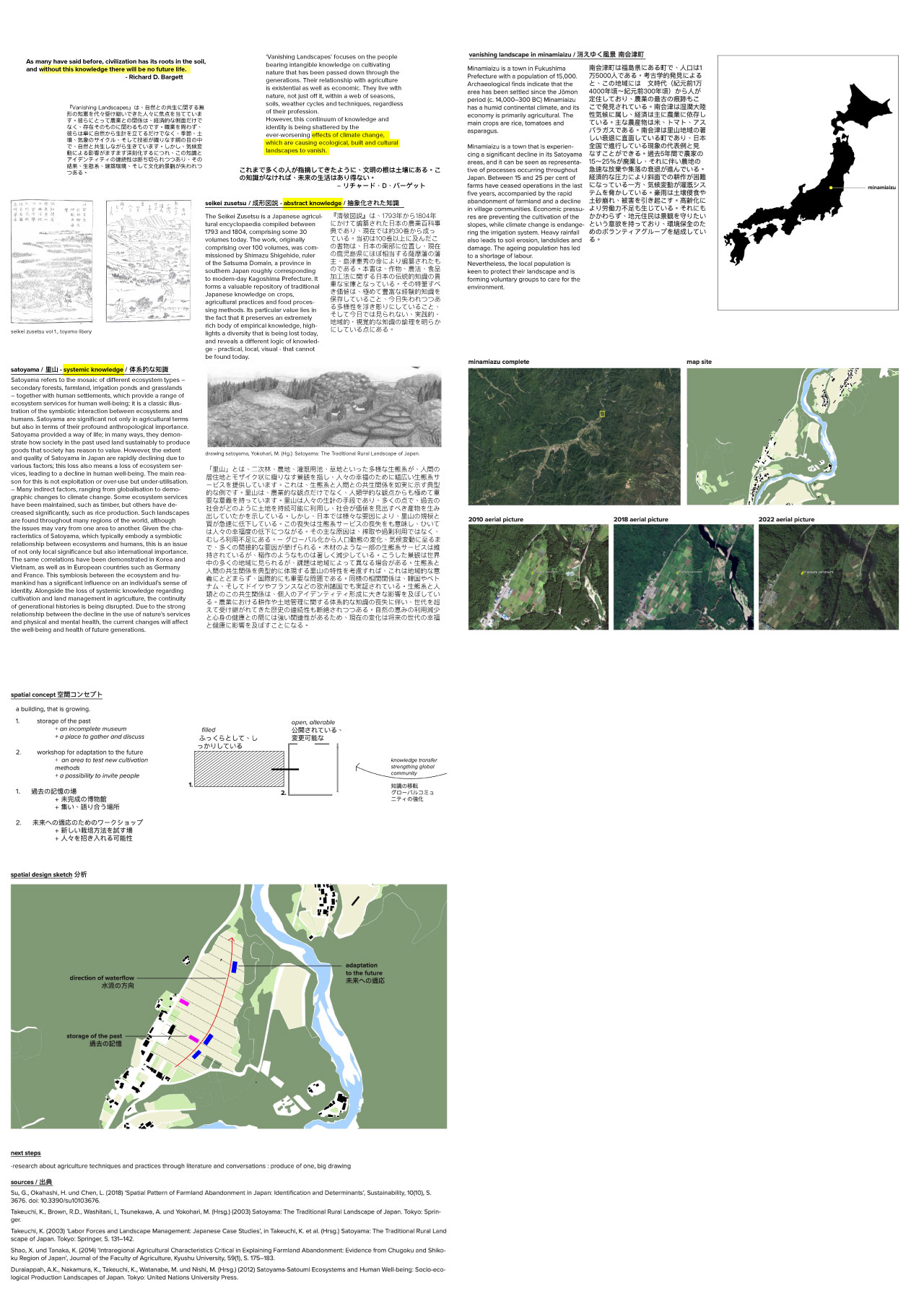
Civilization has its roots in the soil, and this project focuses on the preservation of "vanishing landscapes" where the symbiotic relationship between humans and nature is being severed. In traditional rural areas, such as the Satoyama mosaic of forests, farmland, and irrigation ponds, agriculture is not merely an economic activity but an existential identity woven into the web of seasons, soils, and cycles. However, climate change and economic pressures are causing this continuum of intangible knowledge and identity to disappear, leading to the collapse of both ecological and cultural landscapes.
The project proposes a dual-purpose architectural system centered on "knowledge transfer". The first component is a "Storage of the Past, " an incomplete museum that collects and depicts traditional agricultural practices, referencing historical records such as the 18th-century "Seikei Zusetsu". The second is a "Workshop for the Future, " a space for adaptation where new cultivation methods can be tested and shared. By integrating these two functions, the architecture acts as a hub for both global and local communities to gather, converse, and ensure that the systemic knowledge of the land is adapted and passed on to future generations.
文明の根源は土壌にあり、本プロジェクトは人間と自然の共生関係が断たれつつある「消えゆく風景」の保全に焦点を当てている。森林、農地、ため池が織りなす里山のモザイク状の環境において、農業は単なる経済活動ではなく、季節や土壌、循環の網目の中に組み込まれた「存在そのものに関わるアイデンティティ」である。しかし、気候変動や経済的圧力により、この無形の知恵とアイデンティティの連続性が断ち切られ、生態系と文化的景観の双方が失われつつある。 本提案では、「知識の移転」を核とした二層の建築システムを構築する。一つは、18世紀の『成形図説』などの古記録を参照しつつ、伝統的な農法や生活の記憶を収集・描出する「過去の記憶の場(未完成の博物館)」である。もう一つは、環境変化に対応した新たな栽培方法を試行し共有する「未来への適応のためのワークショップ」である。建築がこれら二つの機能を繋ぐハブとなることで、グローバルとローカルの双方が集い、語り合い、土地の体系的な知識を次世代へと適応・継承していく場を創造する。 |
|
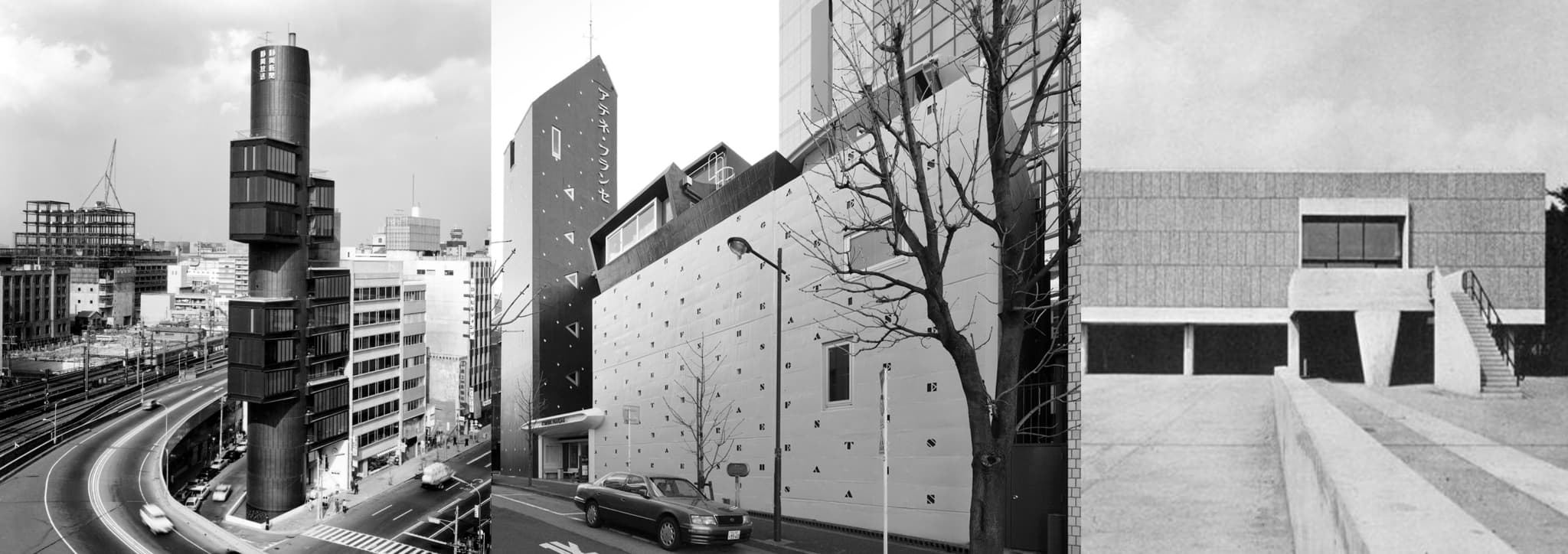
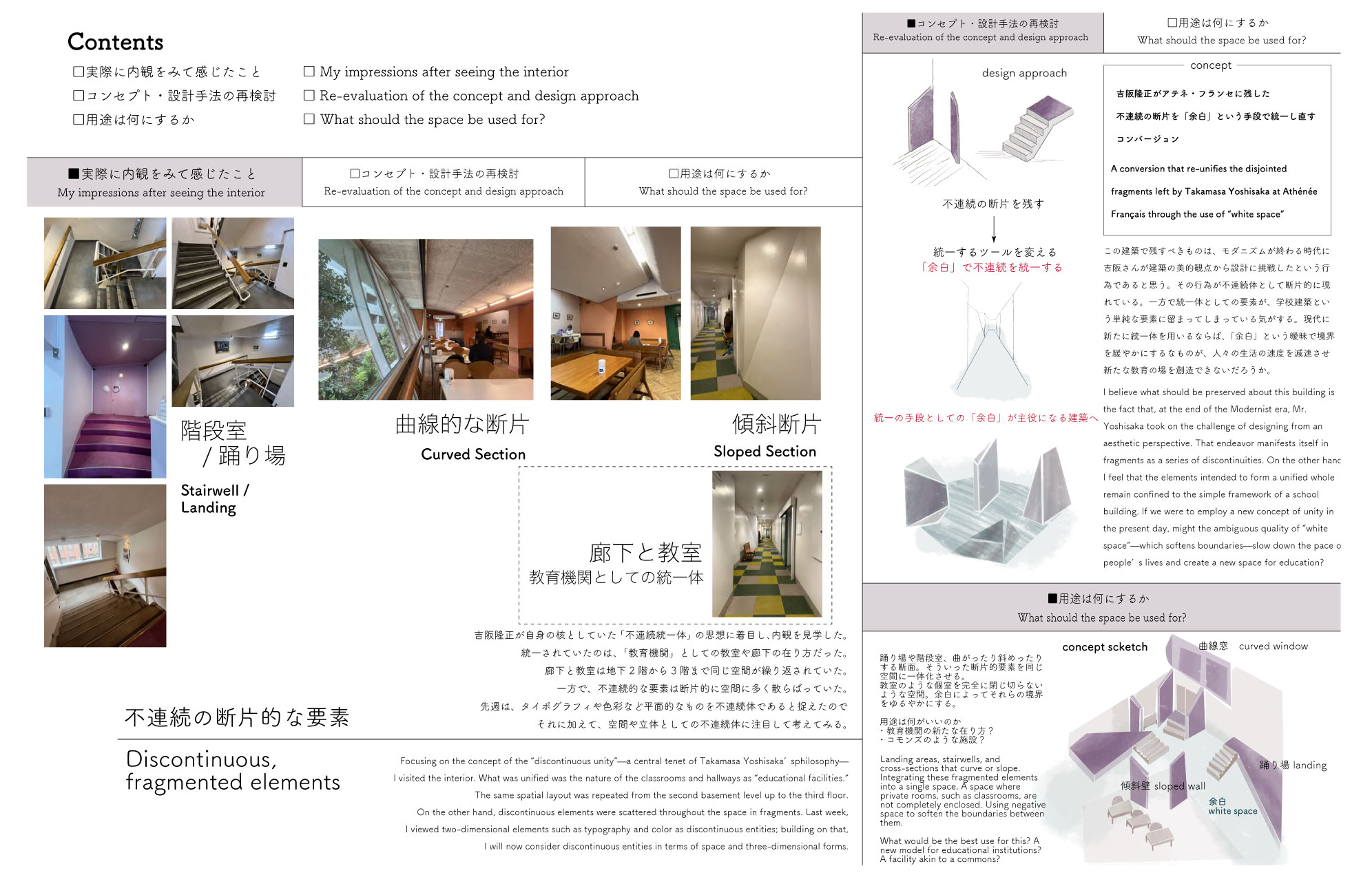
This conversion project re-evaluates the "Athenée Français" through the lens of architect Yoshisaka Takamasa’s philosophy of "Discontinuous Unity". The current building is characterized by fragmented, discontinuous elements such as complex stairwells, curved sections, and sloped floors—features that emerged from Yoshisaka's aesthetic challenge at the end of the Modernist era. However, the project argues that its potential as a unified whole is currently limited by the rigid and simple framework of a conventional school building.
The new design approach introduces "White Space" (yohaku) as a tool to unify these fragmented elements without closing them off. By softening the boundaries between individual rooms and common areas, the architecture aims to integrate curved and sloped fragments into a single, flowing space. This "ambiguous unity" is intended to slow down the pace of daily life and foster a new environment for education that functions as an urban "commons". The goal is to move beyond the traditional institution toward a space where people’s movements and interactions are guided by the inherent rhythm of the architectural fragments.
本コンバージョン計画は、建築家・吉阪隆正が提唱した「不連続統一体」の思想を軸に、アテネ・フランセを再評価する試みである。既存建築には、階段室や踊り場、曲線や傾斜を伴う断面など、モダニズムが終わる時代に吉阪が美的観点から試みた不連続な断片的要素が随所に現れている。しかし、現在の「学校建築」という単純な枠組みが、その統一体としてのポテンシャルを制約してしまっているのではないかという問いを投げかける。 新たな設計手法として、断片的な要素を統合しつつも閉じ切らない「余白」という概念を導入する。教室のような個室の境界を緩やかにし、曲線や傾斜を持つ断片を一つの空間に一体化させることで、人々の生活や学習の速度をあえて減速させる空間を構築する。これにより、従来の教育機関という枠を超え、都市の「コモンズ(共有地)」として機能する新たな学びの場を創造することを目指している。 |
|
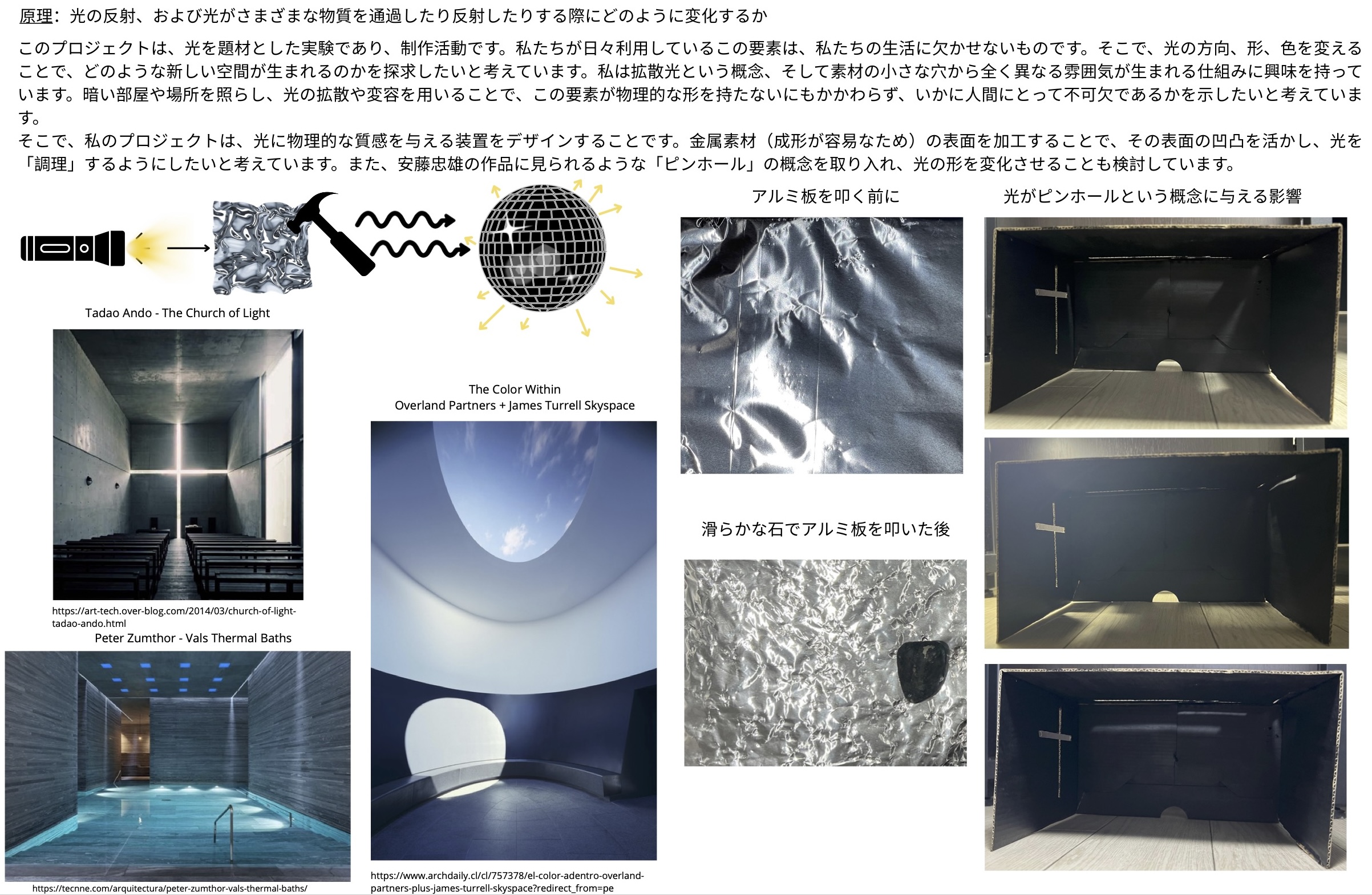
This project explores the manipulation of spatial perception through controlled geometry and viewpoint, challenging the assumed stability of the physical world. Human brains interpret spatial information based on visual cues such as convergence, repetition, scale, and alignment; by intentionally distorting these cues, architecture can create an impression entirely different from physical reality. The study references historical and psychological principles, such as the Ames Room, where distances shift and proportions distort, and the Parthenon, which uses subtle optical corrections (entasis and inclination) to appear geometrically perfect to the human eye.
The proposal designs an architectural apparatus that uses forced perspective and distorted geometry to trick the observer’s senses. As people enter the space, they assume the walls are straight and the floor is level, but as they move through it, they experience a profound sense of misalignment between their self-awareness and the physical proportions. The room itself does not change, but the observer’s perception does, exposing the process by which our senses construct "spatial reality". This intervention serves as a critique of the assumed "truth" of physical space in the age of virtual reality.
本プロジェクトは、制御された幾何学と視点によって空間認識がいかに操作されるかを探求し、物理的な世界の「安定性」という既成概念に問いを投げかけるものである。人間の脳は、収束、反復、スケール、整列といった視覚的な手がかりに基づいて空間を解釈するが、これらの要素を意図的に歪めることで、建築は物理的な実体とは異なる印象を生み出すことができる。リファレンスとして、距離やプロポーションが歪んで見える「エイムズの部屋」の原理や、エンタシス等の微細な補正によって視覚的な歪みを防いでいるパルテノン神殿の知見を活用している。 提案内容は、強制透視図法や歪められた幾何学を適用した、観察者の感覚を欺く建築的装置の設計である。人は壁が直線で床が水平であるという前提で足を踏み入れるが、移動に伴ってプロポーションが歪み、自身の知覚と実空間の間に深い違和感を体験することになる。空間そのものが変化するのではなく、観察者の知覚が変化するプロセスを顕在化させることで、私たちの感覚がいかに「空間的現実」を構築しているかを浮き彫りにし、実空間の「確からしさ」を問い直す。 |
|
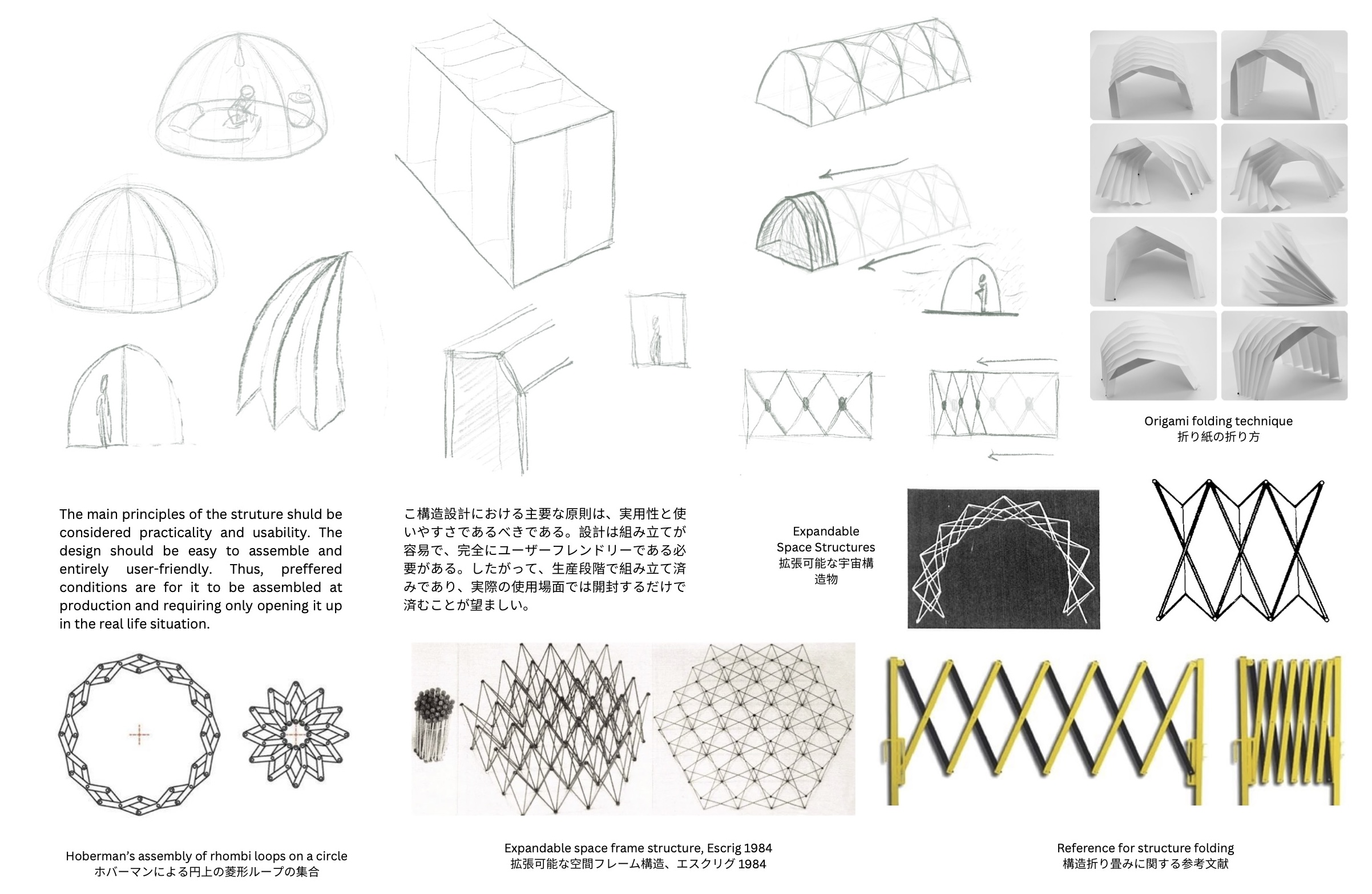
This project aims to improve the temporary living conditions of citizens suffering from conflict and forced evacuation. Millions of people who have lost their homes are currently living in "temporary shelters" that lack privacy and even basic space. The proposal focuses on an easy-to-transport and easy-to-assemble individual housing unit that provides dignity and better living conditions until relocation is possible. The core principles are functionality and simplicity, ensuring that the structures are entirely user-friendly and adaptable to various locations, from city centers to frontlines.
The technical solution centers on a lightweight, foldable structure for the roof using an "origami" folding technique. This allows the units to be highly portable and quickly deployed where needed. At the same time, the modular shape allows the units to be stacked or clustered, creating "urban connections" that enable residents to live in small, supportive communities while maintaining individual and family privacy. Referencing disaster-relief precedents like Shigeru Ban’s work and GK Design’s "QS72, " this modular system is designed not only for war zones but also for locations of natural and human-made disasters.
本プロジェクトは、戦争や避難によって家を失った人々が直面している過酷な生活環境を改善するための提案である。現在、何百万人もの人々がプライバシーの欠如した「仮設シェルター」での生活を強いられており、尊厳を守るためのスペースの確保が急務となっている。本提案は、持ち運びと組み立てが容易な個別の仮設住宅ユニットを構築し、再定住が可能になるまでの間のより良い生活環境を提供することを目指している。設計の核となるのは機能性と簡便さであり、都市部から前線近くまで、どのような場所でも迅速に設置可能な「ユーザーフレンドリー」な構造を追求している。 技術的な特徴として、屋根構造に「折り紙」の技法を採用した軽量・折り畳み可能なシステムを提案している。これにより、高い携帯性と迅速な展開が可能になる。同時に、ユニットはモジュール化された形状をしており、それらを積み重ねたり配置したりすることで、各家族のプライバシーを確保しつつ、住民同士が支え合える「小さなコミュニティ」を都市の中に創出することができる。坂茂の支援活動やGK設計の「QS72」などの先例を参照しつつ、戦時下のみならず自然災害時など、あらゆる緊急時の居住支援に活用可能な汎用性の高いシステムを目指している。 |
Copyright (C) 2014 Watanabe Taishi Laboratory, Department of Architecture, Waseda University. All Rights Reserved.